Gearies Primary School
Social Action Projects: "Citizens of Now"
Participating in high-quality youth social action opportunities has a ‘double benefit’ to both the young person involved and their communities. Young people develop new skills that can support them throughout their lifetime, while their communities benefit from the positive actions of socially responsible and compassionate young citizens.
Research from the Jubilee Centre suggests young people who were first involved in youth social action before the age of 10 are more than twice as likely to have an ongoing commitment to social action (a ‘habit of service’) than those who first participate after the age of 16.
Simply put, youth social action is “young people taking practical action in the service of others in order to create positive social change that is of benefit to the wider community as well as to the young person themselves." From this, we can understand that youth social action is made up of activities that are:
- Practical and directive, such as but not limited to, campaigning, raising awareness, fundraising, and volunteering.
- Undertaken in the service of others or the environment.
- Aimed at addressing real social issues that are important to communities.
- Beneficial to both the wider community and the participants themselves.
We have found that our pupils are capable of taking on an active role as young citizens in our communities. Not only do they have clear ideas about the issues they care about, but they also understand how they can make a difference. Our research reinforces existing evidence that our pupils derive direct benefits from participating in youth social action, including developing leadership, teamwork, problem-solving, and communication skills, as well as a sense of social responsibility, civic self-efficacy, with signs of developing a habit of service.
We have seen our teachers going to great lengths to enable pupils to reap the most of these benefits. This section of website is a celebration of their efforts and achievements, and we hope that it inspires those reading to lead youth social action in their own settings, schools and homes, empowering pupils to be socially responsible citizens of now.
Here are links to some our most recent projects, developed in partnership with the inspirational playwright Neela Doležalová and The Space Between Theatre Company:
At Home I Speak — The Space Between
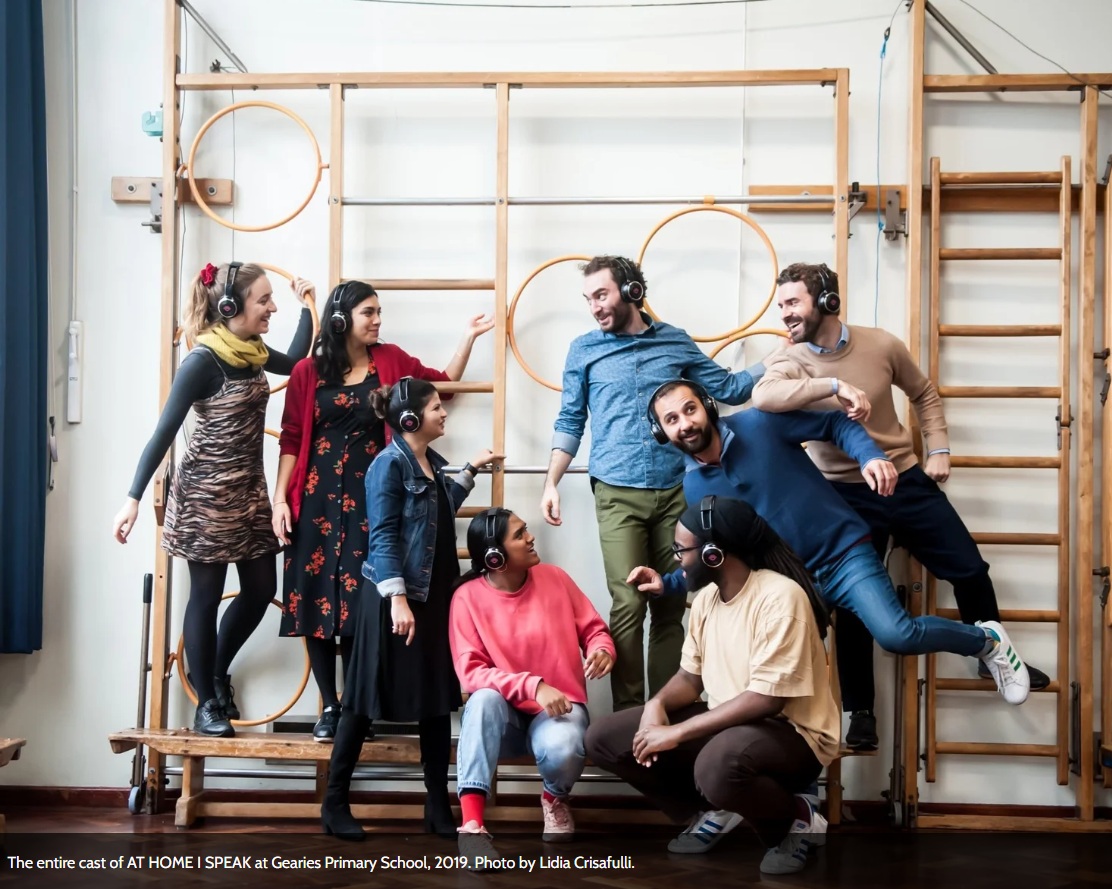
Based on recordings with students, teachers and families, AT HOME I SPEAK explores how the languages we speak (and those we don’t) shape our sense of community, culture and identity. What does it feel like to grow up in a multilingual environment when English fluency is increasingly equated with the right to belong? Does it matter what language we dream in?
Playwright Neela Doležalová and composer Richard Melkonian created with our community, a new play that explores multilingualism in contemporary Britain.
100 Poems for Belonging — The Space Between
An anthology of poems that explores the relationships between home, belonging and language. This collection of poems by young writers at Gearies Primary School aims to remind the reader that our lives are all so different, so similar, and so precious.
1000 Words for Belonging — The Space Between
What does it mean to belong? Are there different types of belonging? What is the difference between belonging and ‘fitting in’? What role does language play in a sense of belonging?
Inspired by the 1000 WORDS FOR WEATHER project, Neela came back to Gearies Primary School to work on a multilingual arts project entitled 1000 WORDS FOR BELONGING. Over one year, all of the students in Year 6 explored the concept of ‘belonging’ through playwrighting, poetry and visual art. The project has been documented on instagram and through the creation of a new podcast.